

Tesamorelin, Waistlines, and the Scale: Why Body Composition Tells a Bigger Story After 50
Understand the differences among body weight, visceral fat, and muscle—and what tesamorelin research reveals about measuring meaningful change.
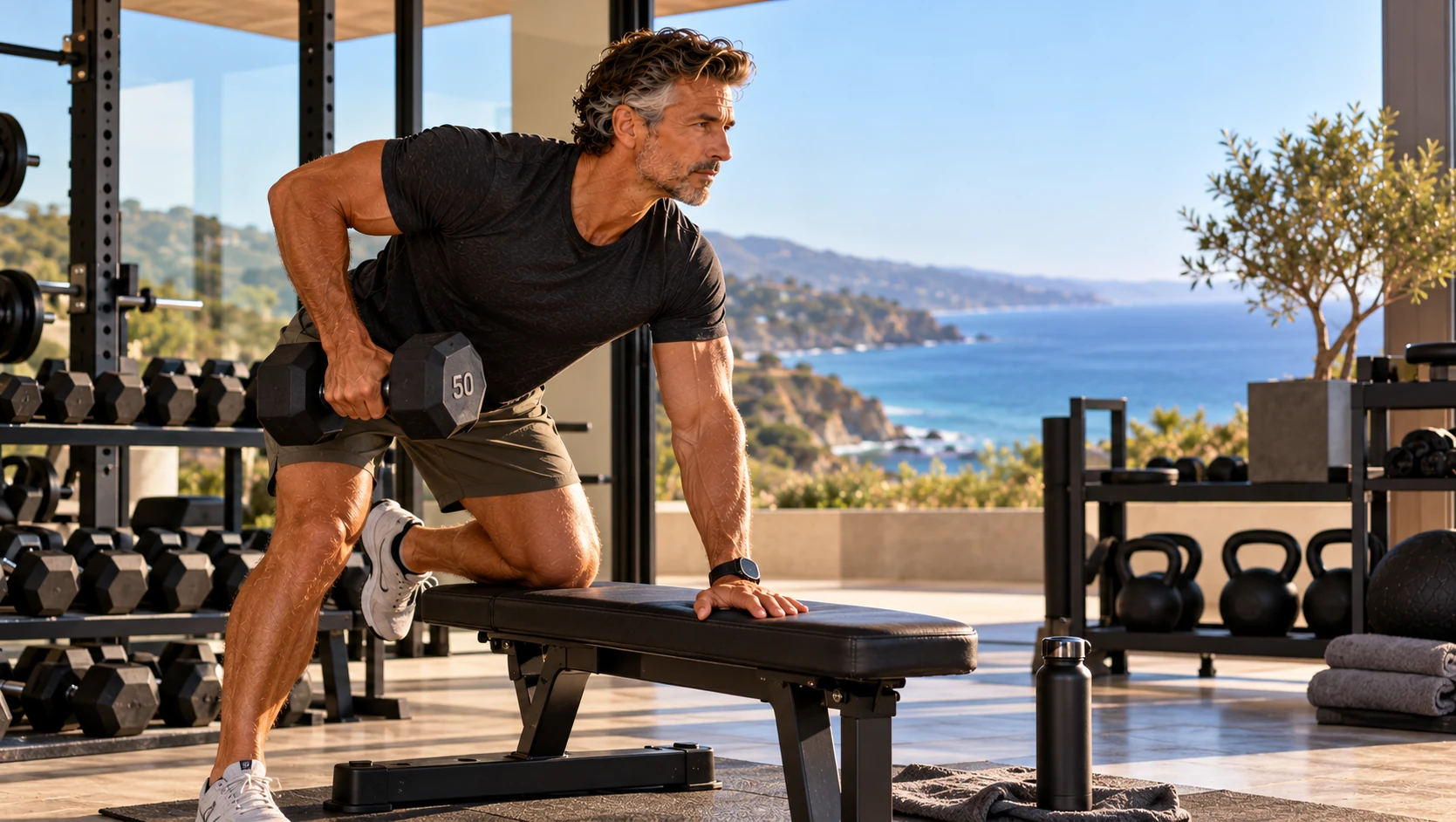
You can spend years watching a number move up and down without learning much about the body beneath it. At 50, the more interesting question is not simply what you weigh. It is what you are building.
Maybe you have trained for decades. You know how to complete a hard workout, how to prepare a protein-rich meal, and how to get through a busy week without abandoning every good habit. Yet the waistline remains stubborn. Some mornings the scale is encouraging; others make you wonder whether any of the work is paying off.
Perhaps a divorce or a milestone birthday prompted you to take your physical health more seriously. You are not trying to recreate your twenties. You want to look like an exceptionally well-maintained man in his fifties or sixties: strong shoulders, a capable body, and the energy to enjoy a life that is still expanding.
That ambition deserves a better measurement strategy. Research on abdominal fat—including studies involving tesamorelin—illustrates why the number on a bathroom scale can never describe the whole story.
The scale combines several different tissues
Your body weight includes muscle, fat, bone, water, organs, and other tissues. A change in weight may reflect shifts in more than one compartment.
This becomes particularly relevant when a man starts lifting seriously while changing his diet. He may gain strength, retain or develop muscle, and reduce fat while his total weight changes slowly. Someone else may lose weight rapidly without making the same gains in physical capability.
Neither outcome can be fully understood from the scale alone.
Body composition offers a more complete framework. Instead of asking only how many pounds were lost, it asks which tissues changed, where fat is distributed, and whether physical function improved.
For the experienced lifter, that is an intuitive idea. You already know that a stronger, leaner 185-pound body can look and perform differently from a less muscular body at the same weight.
The three locations that matter in abdominal-fat discussions
Subcutaneous fat sits immediately beneath the skin. It contributes to the softness you can pinch around your waist.
Visceral adipose tissue is located deeper in the abdomen, around internal organs. It has a different relationship with metabolic health and is a central subject in research on abdominal fat distribution.
Fat can also accumulate in organs, including the liver. This is often discussed as ectopic fat because it is stored in locations other than the body's usual adipose depots.
These compartments are related but not identical. A person can change total body weight without experiencing exactly the same change in every fat depot.
That is one reason researchers use imaging techniques such as computed tomography (CT (Computed Tomography)) and magnetic resonance imaging (MRI (Magnetic Resonance Imaging)) to examine internal fat distribution. A tape measure is useful, but it cannot identify each compartment precisely.
Why scientists pay attention to visceral fat
Visceral fat is associated with several cardiometabolic risk factors, including insulin resistance and unfavorable lipid patterns. It is biologically active tissue that participates in signaling and metabolic regulation.
The association does not mean that one fat measurement determines an individual's future. Blood pressure, activity, genetics, sleep, glucose regulation, and other factors remain important.
Still, visceral fat helps explain why body composition deserves attention beyond appearance. The health implications of abdominal fat can depend partly on where it is stored.
For a man in his fifties, this creates a useful distinction between two goals. One is cosmetic: looking better in a fitted shirt. The other is physiological: understanding and improving the factors that contribute to long-term health.
The strongest reinvention plan makes room for both.
Where tesamorelin enters the research
Tesamorelin is a synthetic analogue of growth hormone-releasing factor, also called growth hormone-releasing hormone (GHRH (Growth Hormone-Releasing Hormone)). It stimulates the pituitary gland to release growth hormone, with downstream effects involving insulin-like growth factor 1 (IGF-1 (Insulin-Like Growth Factor 1)).
Its approved medical use concerns reduction of excess abdominal fat in adults with human immunodeficiency virus (HIV (Human Immunodeficiency Virus))-associated lipodystrophy. This is a defined clinical condition, not a general indication for weight loss or cosmetic abdominal definition.
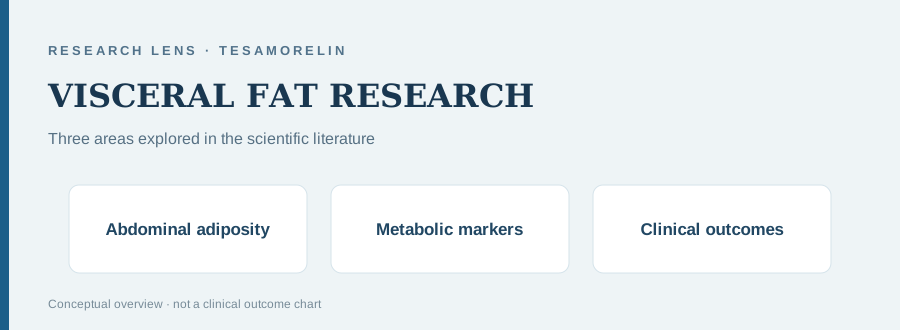
In trials involving that population, investigators measured visceral adipose tissue using imaging rather than relying solely on scale weight. That choice of endpoint is central to understanding the research.
The question was not simply whether participants weighed less. It was whether a particular internal fat compartment changed under study conditions.
That is a sophisticated way to think about body composition—and a useful lesson even for readers who have never encountered the compound before.
The research question was more precise than “lose belly fat”
Clinical trials of tesamorelin in adults with human immunodeficiency virus (HIV (Human Immunodeficiency Virus))-associated excess abdominal fat reported reductions in visceral adipose tissue relative to placebo.
The findings contributed to its clinical development for the specific indication studied. Researchers also evaluated selected metabolic measures and safety outcomes.
The distinction between a measured reduction in visceral fat and a broad promise of weight loss matters. A treatment can affect a particular tissue compartment without producing the same pattern of change in every other tissue.
Likewise, evidence in one medical population cannot automatically be applied to otherwise healthy adults pursuing a cosmetic goal.
Understanding what the trials actually measured allows the scientific achievement to stand on its own terms.
The most interesting changes in body composition are not always visible on the scale.
Tesamorelin research: The scale combines several different tissues
Explore US Peptide Depot →The strength-preservation perspective
Imagine two men who both reduce their waist circumference over six months.
One has continued lifting and maintained his strength. He can carry luggage, perform pull-ups, and enjoy a long hike without feeling depleted. The other has focused exclusively on eating less and has gradually abandoned training.
A tape measure alone cannot tell you which man has built the more capable body.
That is why strength belongs in any meaningful body-composition conversation. Muscle supports movement and contributes to glucose metabolism and physical resilience.
For men over 50, resistance training remains a powerful way to preserve and improve function. It also gives the body a reason to retain muscular capacity during periods of fat loss.
You do not have to train like a competitive bodybuilder. You need a program you can repeat, progress, and recover from.
The goal is not just a leaner appearance. It is a physique that continues working for you.
A better dashboard for a better decade
A useful health dashboard should answer real questions rather than collect numbers for their own sake.
Body weight can show broad trends, especially when considered over weeks instead of individual mornings.
Waist circumference provides an accessible indicator of abdominal size, although it does not directly measure visceral fat.
Strength and training performance reveal whether your capacity to produce force and perform physical tasks is being maintained.
Cardiovascular fitness and daily movement help describe endurance and activity levels.
Blood pressure and selected laboratory measures can provide important clinical context when interpreted appropriately.
The purpose of these measurements is not to become obsessed with data. It is to understand whether the choices you are making are producing the life you want.
A man who knows what matters can stop chasing every daily fluctuation and start evaluating meaningful trends.

Why this matters to the man starting over
Consider a man who has just ended a relationship that lasted more than a decade. He is 53, professionally established, and trying to imagine what the next chapter looks like.
He starts with the gym because it offers something concrete. He can show up, do the work, and measure progress.
Then he begins making other changes. He cooks more often. He walks in the mornings. He replaces clothing that no longer suits him. He becomes interested in health research because he wants to understand why some approaches work better than others.
The change is not only physical. It is a return to personal agency.
He no longer wants to spend his evenings wondering whether someone from his past will notice his progress. He wants to build a life that feels satisfying regardless.
Body composition becomes one part of that larger reinvention: a visible sign of deliberate effort, supported by a deeper commitment to health.
A stronger future begins with understanding the body you intend to take care of.
Go deeper: A better dashboard for a better decade
Discover US Peptide Depot →Why fat distribution is a longevity topic
The appeal of longevity research is not simply the possibility of adding years to life. For many men, the more compelling goal is to preserve independence and capability.
You want to walk comfortably through a new city, spend an afternoon playing golf, or return to racquetball without worrying that ordinary activity will exhaust you.
Cardiometabolic health contributes to those possibilities. It is shaped by many factors, including body composition, physical activity, nutrition, sleep, and medical conditions.
Visceral-fat research helps scientists understand one component of that picture. It also demonstrates why different fat compartments deserve separate study.
For the reader, the lesson is to think beyond a narrow definition of success. A smaller waist is satisfying. A stronger body and better metabolic health make the achievement more meaningful.
Understanding clinical context
Tesamorelin has a specific approved indication involving excess abdominal fat in adults with human immunodeficiency virus (HIV (Human Immunodeficiency Virus))-associated lipodystrophy.
The clinical evidence supporting that indication should not be treated as proof of equivalent outcomes for men without that condition. The prescribing information also addresses clinically important risks and monitoring considerations, including effects involving insulin-like growth factor 1 (IGF-1 (Insulin-Like Growth Factor 1)) and glucose regulation.
These details are part of understanding how a medical intervention is studied and evaluated.
They also illustrate a broader principle: the quality of an evidence-based claim depends on matching it to the population, dose, formulation, and outcome actually investigated.
That is the standard that makes research useful rather than merely impressive-sounding.
The advantage of thinking in years
The most impressive transformations often look ordinary while they are happening.
A man lifts three times a week. He walks after dinner. He protects his sleep. He pays attention to how he feels and performs. He adjusts when life becomes busy, but he does not abandon the plan.
Months pass. Then years.
His waistline changes. His posture improves. He becomes stronger at movements that once felt difficult. He feels more comfortable traveling, socializing, and taking on new experiences.
That is the quiet power of a long-term strategy. It creates progress that fits into life instead of requiring life to stop.
At 60, he may have more gray hair than he did at 50. He may also be leaner, more capable, and more satisfied with the direction of his life.
That is a meaningful definition of reinvention.
The next chapter is bigger than the mirror
Imagine waking up at 63 with a day full of possibilities.
You have a workout planned, a trip coming up, and people you look forward to seeing. Your body is strong enough to participate in the experiences you value.
You no longer compare every photograph with one from your twenties. You are interested in becoming an exceptional version of yourself at the age you are.
Scientific curiosity belongs in that vision. It encourages better questions about metabolism, muscle, and the systems that influence health.
So does consistency. The most useful knowledge is the kind you can integrate into a deliberate way of living.
The next decade will arrive. What matters is how you prepare for it.
Final perspective
Tesamorelin research demonstrates the value of studying visceral abdominal fat as a distinct body-composition endpoint in a defined clinical population.
For men over 50, the broader lesson is that the scale is only one part of the picture. Fat distribution, muscular strength, physical function, and metabolic health all contribute to the quality of a transformation.
The objective is not merely to weigh less. It is to build a body that supports the life you want to lead.
The next chapter deserves a better measure of success.
Keep exploring Why Body Composition Tells a Bigger Story After 50: The next chapter is bigger than the mirror
Visit US Peptide Depot →Further reading on Reinvention Science
- Tesamorelin Research After 50: Visceral Fat, Clinical Evidence, and a More Intelligent Approach to Aging
- Tesamorelin and Visceral Fat After 50: Understanding the Fat You Cannot Pinch
Scientific references
- Falutz J, et al. (2007). Metabolic effects of a growth hormone-releasing factor in patients with human immunodeficiency virus. New England Journal of Medicine.
- Stanley TL, et al. (2014). Tesamorelin research on visceral and liver fat.
- United States Food and Drug Administration (FDA): tesamorelin regulatory record.
- Visceral adiposity and cardiometabolic risk: research overview.
- Fragala MS, et al. (2019). Resistance Training for Older Adults: Position Statement. Journal of Strength and Conditioning Research.
- DailyMed: EGRIFTA WR (tesamorelin), updated July 29, 2026. Current United States prescription labeling and indication-specific limitations.
Get the weekly digest
One email a week. Unsubscribe anytime.
More in Metabolic Health
Tirzepatide After 50: Fat Loss, Muscle, and the Physique You Want to Build
October 13, 2026 — Explore the research on tirzepatide, appetite regulation, fat mass and lean mass, and why body composition matters for men over 50.
Tirzepatide and Appetite After 50: Why Hunger Is More Than Willpower
October 12, 2026 — Understand the appetite-regulating biology behind tirzepatide, the clinical research, and why sustainable fat loss matters to men rebuilding their health after 50.
Tirzepatide and Strength Training After 50: Building a Better Body-Composition Strategy
October 11, 2026 — Discover how strength training, nutrition, and body-composition research connect with tirzepatide and the ambitions of active men over 50.
Discussion
Loading comments…