

Semax and Mental Clarity After 50: The Science of Attention, Focus, and Cognitive Performance
Explore Semax research, attention, brain signaling, and practical cognitive resilience for men over 50.

The man you want to become at 60 needs more than a strong body. He needs a mind that stays curious, attentive, and capable of doing meaningful work.
At 52, you may have more experience than ever before. You have negotiated difficult situations, built relationships, and learned how to distinguish an urgent problem from an important one. Yet the sheer volume of modern information can make sustained concentration feel harder to find.
Messages interrupt your morning. Meetings consume your afternoon. When you finally sit down to work on something that matters, you discover how difficult it can be to protect an uninterrupted hour.
Perhaps you have recently left a long relationship or decided to build another business. You want your next chapter to be deliberate. That means taking care of your thinking as seriously as you take care of your training.
This is one reason the experimental peptide Semax has attracted attention in discussions of neuroscience. Its research history involves neurochemical signaling and neurological investigations, primarily from Russian scientific literature. Understanding that history offers a window into the larger science of attention and cognitive performance.
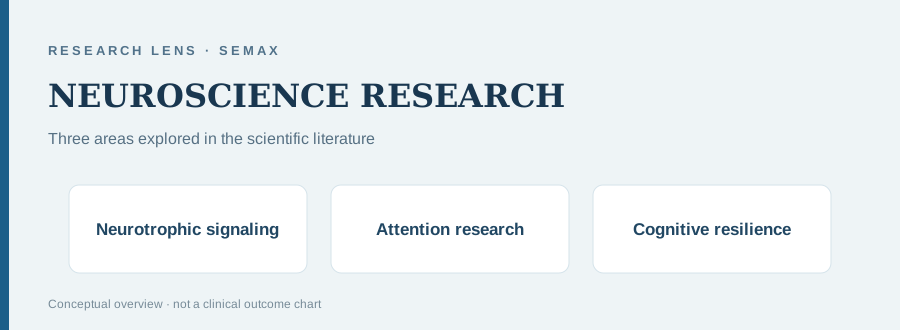
Attention is a skill and a biological process
Attention is not a single switch that is either on or off. The brain continually selects information, directs resources, suppresses distractions, and adjusts priorities.
Some forms of attention help you sustain concentration on one task. Others help you shift between competing demands. Working memory temporarily holds information while you reason, calculate, or make a decision.
These functions depend on coordinated networks distributed across the brain. Sleep, stress, physical health, mood, and the environment can all affect how well they operate.
For the experienced professional, the goal is not necessarily to process more information every minute. It is to reserve enough mental capacity for the decisions and projects that matter most.
A man who protects his concentration can create something meaningful instead of spending every day reacting to other people's priorities.
What Semax is
Semax is a synthetic peptide derived from a fragment of adrenocorticotropic hormone (ACTH (Adrenocorticotropic Hormone)), with modifications intended to influence its stability and biological behavior.
It has been investigated in Russian research settings for neurological and cognitive-related questions. Some publications examine neurochemical mechanisms; others concern clinical populations with neurological conditions.
That distinction matters because evidence from a patient recovering from a neurological event is not equivalent to evidence of improved concentration in a healthy middle-aged professional.
Semax is not approved by the United States Food and Drug Administration (FDA) for improving focus, memory, or cognitive performance. The available literature includes methodological and accessibility limitations that make broad claims difficult to substantiate.
Still, the research is relevant to understanding how scientists investigate the relationships among peptide signaling, brain physiology, and cognition.
The brain's signaling environment
Neurons communicate through electrical activity and chemical signals. The strength and organization of these connections influence how information is processed.
Researchers investigating cognition examine neurotransmitter systems, neurotrophic factors, synaptic plasticity, and the brain's responses to injury or stress.
One widely studied molecule is brain-derived neurotrophic factor (BDNF (Brain-Derived Neurotrophic Factor)), which participates in neuronal survival and plasticity. Some experimental Semax literature has examined changes in neurotrophic-related signaling.
A change in a signaling molecule can help generate a hypothesis about what is happening in a biological system. It is not by itself proof of improved memory, attention, or everyday performance.
That is an important feature of neuroscience. The distance between a molecular observation and a meaningful change in human behavior can be substantial.
What the Semax literature explores
The Semax literature has investigated several overlapping areas: neurochemical responses, neurological injury models, and selected clinical outcomes in defined patient groups. A United States Food and Drug Administration scientific evaluation also catalogues small studies in healthy volunteers and clinical reports involving other populations; it distinguishes the studied intranasal route from injectable formulations for which comparable human safety data were not identified.
Experimental work has examined gene expression and signaling pathways associated with neuronal function. Some clinical reports have explored use in neurological care settings outside the United States.
For a reader interested in cognitive performance, the essential research question is precise: what was measured, in whom, and against which comparison?
A study of a laboratory pathway is different from a randomized trial measuring sustained attention. A report from a neurological patient population is different from a study of healthy adults managing ordinary work demands.
Understanding these differences makes the field easier to follow without turning early observations into promises.
The science of cognition begins with curiosity about how the brain adapts, learns, and responds to its environment.
Semax research: Attention is a skill and a biological process
Explore US Peptide Depot →Why focus becomes part of reinvention
Imagine a man who is 55 and starting over after a difficult breakup. He has spent months thinking about what happened and what comes next.
He begins walking in the mornings. He returns to the gym. He notices that structured physical activity helps him organize his days.
Then he turns his attention to a neglected ambition: a book, a business idea, a course, or a creative project he has wanted to pursue for years.
Suddenly, concentration has a new purpose. He is not trying to be more productive merely to answer more emails. He wants to build something that belongs to his future.
This is where cognitive health becomes deeply personal. Mental clarity is valuable because it allows you to choose what deserves your time.
It also helps you remain open to learning. A man who is willing to become a beginner again at 55 has not lost his ambition. He has found a new way to use it.
What the strongest everyday evidence supports
The fundamentals of cognitive well-being deserve attention before any experimental intervention enters the discussion.
Regular physical activity supports cardiovascular health and is associated with benefits for brain health. Resistance training adds physical strength and structure to the week.
Sleep supports memory consolidation, attention, and emotional regulation. Inadequate sleep can make ordinary cognitive tasks feel much more demanding.
Managing blood pressure, diabetes, hearing loss, and other relevant health conditions can also matter for long-term cognitive health.
Social connection, meaningful activity, and continued learning provide opportunities to remain mentally engaged.
None of these requires a dramatic reinvention overnight. They are habits that can be built gradually, then sustained for years.
The difference between stimulation and meaningful focus
A person can feel mentally stimulated without accomplishing meaningful work. Notifications, novelty, and constant switching can create a sense of activity while leaving important tasks untouched.
Deep concentration often requires a quieter environment. It helps to define one clear objective, reduce interruptions, and protect a block of time long enough to make progress.
For a business owner, that might mean a morning devoted to strategy rather than reacting to messages. For a musician, it could mean an uninterrupted session learning a production technique. For a man rebuilding his social life, it might mean giving someone his full attention during a conversation.
The quality of attention changes the quality of experience.
That is why cognitive performance should not be reduced to a promise of feeling sharper. The real question is whether you can use your mind to do the things you care about.

Measuring cognitive progress thoughtfully
Cognition is difficult to summarize with one number. Attention, processing speed, memory, and executive function are related but distinct abilities.
A scientifically useful study chooses an outcome that matches the question being investigated. Standardized tasks may measure reaction time, accuracy, recall, or sustained attention.
For everyday life, practical markers can be simpler: whether you complete a focused work session, remember commitments, follow through on projects, or remain engaged during conversations.
These personal observations are not substitutes for formal testing, but they can help you understand your routines and identify changes worth discussing when appropriate.
The objective is not to become obsessed with every moment of distraction. It is to build conditions in which your attention has a better chance to work well.
A sharper next chapter begins with deciding what is worth your attention.
Go deeper: What the strongest everyday evidence supports
Discover US Peptide Depot →The research questions that still matter
Future research on experimental neuroactive peptides needs to establish reliable clinical outcomes, safety, and reproducibility in well-defined populations.
For Semax, questions about formulation, delivery, study design, and the transferability of findings across settings are particularly important.
A compelling biological mechanism does not replace careful human research. The strongest studies connect an intervention with outcomes people can actually recognize and measure.
That scientific process is valuable even when it produces a more complicated answer than a marketing headline.
It helps readers separate a research hypothesis from a demonstrated clinical result and understand why different studies sometimes reach different conclusions.
For an independently minded man who values evidence, this is part of the appeal of serious science: it invites investigation rather than demanding blind belief.
Building a mind that stays engaged at 65
Imagine yourself ten years from now. You are physically active and comfortable with your age. You have meaningful relationships and a few projects that make you excited to start the day.
Perhaps you have learned golf, returned to music production, or built a new company. Perhaps you travel and enjoy conversations with people whose experiences differ from your own.
You still read. You still ask questions. You are willing to change your mind when new evidence deserves it.
Your intellectual life has not become smaller simply because you are older. It has become more selective and intentional.
That is a powerful definition of cognitive vitality. It is not merely the absence of distraction. It is the presence of curiosity, purpose, and the capacity to keep participating in life.
The advantage of experience
At 25, you may have had more uninterrupted time and fewer responsibilities. At 55, you have something else: a deeper understanding of what matters.
Experience can improve judgment, perspective, and the ability to recognize patterns. Those strengths deserve to be supported by habits that protect attention and physical health.
The next decade is an opportunity to combine mature judgment with renewed energy and curiosity.
You do not need to chase every new idea. You can investigate promising science, choose useful routines, and keep your ambitions grounded in a life you genuinely want to live.
That is the Reinvention Science approach: understand the evidence, remain curious, and keep building.
Final perspective
Semax is an experimental peptide with a research history involving neurological and neurochemical questions. Its study provides one perspective on how scientists investigate signaling pathways related to brain function.
For men over 50, the larger story is the importance of protecting attention, continuing to learn, and remaining engaged with meaningful work and relationships.
The next chapter does not require becoming a younger version of yourself.
It requires staying curious enough to become a better version of the man you are now.
Keep exploring The Science of Attention, Focus, and Cognitive Performance: The advantage of experience
Visit US Peptide Depot →Further reading on Reinvention Science
- Semax After 50: Exploring Brain Signaling, Neuroplasticity, and Cognitive Resilience
- Semax and Concentration After 50: The Science of Attention in a Distracted World
Scientific references
- Dolotov et al. (2006): Semax and brain-derived neurotrophic factor signaling in rats. Experimental animal study.
- Dolotov et al. (2006): Semax and brain-derived neurotrophic factor in rat basal forebrain. Experimental animal study.
- National Institute on Aging: Cognitive Health and Older Adults. Evidence-based background on cognitive health.
- World Health Organization: Risk Reduction of Cognitive Decline and Dementia. Public-health guidance on modifiable cognitive-health factors.
- United States Food and Drug Administration: Scientific Evaluation of Semax (Free Base) and Semax Acetate. Regulatory scientific review of the available literature, study populations, and limitations of the evidence.
Get the weekly digest
One email a week. Unsubscribe anytime.
More in Cognitive Science
Semax After 50: Exploring Brain Signaling, Neuroplasticity, and Cognitive Resilience
September 22, 2026 — Explore Semax research, brain signaling, neuroplasticity, and the science of cognitive resilience in midlife.
Discussion
Loading comments…