

Semax After 50: Exploring Brain Signaling, Neuroplasticity, and Cognitive Resilience
Explore Semax research, brain signaling, neuroplasticity, and the science of cognitive resilience in midlife.

There is a particular kind of confidence that comes from remaining curious. You can have silver hair, decades of experience, and an entirely new set of ambitions—and still feel that your mind has more to discover.
Imagine a man of 56 who has spent most of his adult life solving problems. He has managed teams, negotiated difficult decisions, and built a life that looks successful from the outside. But recently he has started thinking about a different kind of performance. Not how much he can accomplish in a day, but how clearly he can think while doing it.
He wants to concentrate deeply on a new project. He wants to learn an instrument, understand a foreign language, or master a sport that requires coordination and attention. Perhaps he is rebuilding his life after a relationship ended. The next chapter demands both courage and mental flexibility.
That curiosity leads naturally toward neuroscience: the study of how brain cells communicate, respond to experience, and adapt over time. Among the experimental compounds discussed in this field is Semax, a synthetic peptide investigated in neurobiology and in a limited clinical literature, much of it originating in Russia.
The most compelling subject is not a shortcut to intelligence. It is the extraordinary capacity of the brain to change, learn, and respond to the world throughout adult life.
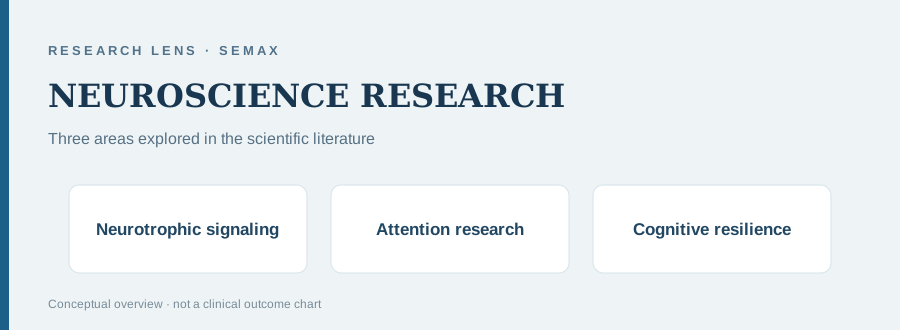
Cognitive performance is more than memory
When people say they want to stay mentally sharp, they may mean several different things. One person wants to remember names. Another wants to sustain attention through a difficult meeting. Someone else wants to learn new skills or make decisions without becoming distracted.
These abilities overlap, but they are not identical. Attention helps select relevant information. Working memory allows information to be held and manipulated briefly. Executive function supports planning and inhibition. Learning involves changes in the brain's response to experience.
A good scientific discussion starts by identifying which of these outcomes is being studied. An experiment measuring a molecular signal is different from a trial measuring attention on a validated test. A report of subjective alertness is different from evidence of improved long-term cognition.
For a man over 50, that distinction is useful. It allows him to build a more precise picture of the mental capabilities he wants to maintain and develop.
What Semax is
Semax is a synthetic heptapeptide: a chain of seven amino acids derived from a fragment of adrenocorticotropic hormone (ACTH (Adrenocorticotropic Hormone)), with additional amino acids included in its sequence.
Researchers have examined Semax in experimental models of neural signaling, stress responses, and neurological injury. It has also been studied in some clinical settings outside the United States, including work relating to stroke recovery.
Its scientific history differs from that of widely approved medicines used for common conditions in the United States. Semax is not approved by the United States Food and Drug Administration (FDA) as a treatment for cognitive enhancement.
This matters when interpreting studies. The available literature contains different research designs, populations, and endpoints. Some studies investigate molecular responses in animals; others examine clinical outcomes in defined patient groups.
For readers who enjoy exploring emerging science, understanding the research context makes the subject far more interesting than a simple claim about improved focus.
Brain cells communicate through networks
The brain is made up of enormous networks of cells. Neurons communicate through electrical activity and chemical messengers. Supporting cells help maintain the environment in which those signals occur.
A thought, a memory, or a movement is not produced by one molecule acting alone. It emerges from patterns of activity across networks that continually respond to the body and the surrounding world.
This is why neuroscience can be both fascinating and humbling. A change in one molecular pathway may matter, but it must be interpreted within a much larger system.
Semax research has examined changes in gene expression and signaling pathways in experimental neurological models. Such work helps scientists formulate hypotheses about how peptide signaling may interact with neural cells.
The broader lesson is that brain performance depends on coordination, not a single switch that can simply be turned up.
The science of neuroplasticity
Neuroplasticity refers to the nervous system's ability to change its organization or function in response to experience, activity, and injury. It is central to learning and adaptation.
When you practice a difficult movement, study a language, or repeat a musical passage, the brain is participating in processes that can strengthen or modify neural connections. These changes depend on many biological mechanisms and occur over different timescales.
Scientists study signaling molecules involved in neural growth, survival, and synaptic function. One frequently discussed molecule is brain-derived neurotrophic factor (BDNF (Brain-Derived Neurotrophic Factor)), a protein involved in aspects of neural development and plasticity.
Some preclinical Semax studies have explored neurotrophin-related pathways and changes in gene expression. Human investigations have also examined short-term brain-network imaging, a physiological measurement distinct from validated tests of memory or attention. These investigations provide mechanistic questions for further research; they are not the same as demonstrating improved concentration or memory in healthy adults.
The subject remains compelling because it connects molecular biology with the everyday human experience of learning something new.
Why this matters to a man beginning again
Picture a man who has just turned 55. He has been through a difficult breakup and is living alone for the first time in years. His routines have changed, and the future feels unusually open.
He decides not to spend that freedom looking backward. He starts lifting weights consistently. He signs up for golf lessons. He returns to a creative project he abandoned years ago.
All three require learning. He must pay attention, tolerate mistakes, and return to the task after a frustrating day.
There is something powerful about discovering that growth remains possible. He may not learn in exactly the same way he did at 20, but experience gives him patience and a better understanding of how to practice deliberately.
This is the emotional relevance of cognitive science. It reminds us that the brain remains an active participant in reinvention.
A new chapter begins with curiosity about what the mind can still learn.
Semax research: Cognitive performance is more than memory
Explore US Peptide Depot →What experimental Semax studies investigate
Published Semax research includes animal experiments investigating neurological injury, changes in gene activity, and selected signaling pathways. Some papers examine responses following reduced blood flow to the brain; others explore molecular markers under experimental conditions.
These models are valuable because they allow researchers to ask focused questions that would be difficult to isolate in everyday life. Scientists can compare defined groups and examine biological changes under controlled conditions.
But an experimental neurological injury model is not the same as a healthy professional seeking better concentration. The study population, exposure, and outcome all influence what conclusions can be drawn.
The clinical literature is also geographically concentrated and includes studies whose methods and reporting differ from contemporary large, independently replicated trials.
For an informed reader, the right approach is to follow the actual question being tested. What biological process was measured? What kind of subject was studied? What was the comparison group? What outcome changed?
That is how curiosity becomes scientific literacy.
Attention in a distracted world
Not every challenge with concentration begins inside the brain. Modern environments compete constantly for attention.
Notifications interrupt work. Meetings fragment the day. Social feeds offer endless novelty. Poor sleep can make it harder to resist distraction, while stress can occupy the mental space needed for complex thinking.
A man who wants to work deeply on a new project may benefit from examining his environment before concluding that his brain has lost its edge.
Protected blocks of uninterrupted time, adequate sleep, physical activity, and deliberate breaks can support a more focused daily routine. These practices do not require an elaborate system.
The advantage of maturity is that you can decide what deserves your attention. You do not need to react to every interruption simply because it arrives.
That kind of focus is as much a lifestyle choice as a cognitive skill.

The relationship between movement and the brain
Physical activity is often discussed in terms of the heart, muscles, and waistline. Its relationship with brain health is equally interesting.
Exercise influences blood flow, metabolic regulation, mood, and several biological pathways relevant to cognitive function. Research on physical activity and aging has explored associations with executive function and other cognitive outcomes.
For a man already committed to resistance training and walking, this creates an appealing connection. The habits that support physical capability can also contribute to a broader foundation for brain health.
A morning walk may offer time to think without interruption. A demanding workout requires coordination and attention. Learning a new sport introduces movement patterns that challenge both body and mind.
These are not replacements for clinical treatment when a cognitive disorder is present. They are ways to remain active and engaged with the world.
The pursuit of physical vitality and mental engagement can belong to the same reinvention.
Go deeper: Attention in a distracted world
Discover US Peptide Depot →Sleep, stress, and cognitive resilience
A restless night can make even familiar tasks feel unusually demanding. Sleep plays important roles in attention, emotional regulation, and memory-related processes.
Chronic stress can also interfere with concentration. A mind occupied by unresolved conflict may have less capacity available for a difficult project or a new skill.
This is especially relevant after a major life transition. Divorce, financial uncertainty, and changes in routine can all place demands on attention.
Building a reliable daily structure can help. Regular sleep, exercise, time outdoors, and meaningful social connection provide a foundation for functioning well.
For the man rebuilding his life, these habits also offer something psychologically important: a sense of agency. He can choose how to organize the day even when he cannot control every external event.
The ability to direct attention toward what matters may be one of the most useful skills of midlife.
How to read cognitive research intelligently
Cognitive research uses many different measurements. Some studies examine proteins or gene expression. Others use behavioral tests. Clinical trials may measure recovery after a neurological event.
Those outcomes should not be combined into one broad promise of enhanced intelligence or concentration.
For Semax, research on neural pathways provides an interesting biological foundation, but its effectiveness and long-term safety for cognitive enhancement in healthy adults have not been established through large, rigorous trials.
A thoughtful reader can appreciate the experimental findings while understanding the difference between mechanism, clinical evidence, and marketing language.
That perspective is consistent with the broader values of Reinvention Science: respect the reader's intelligence, explain the biology clearly, and let curiosity lead toward better questions.
A more compelling definition of mental sharpness
Imagine yourself at 65. You are reading a challenging book, learning a new piece of music, or planning a trip to somewhere you have never been.
You are comfortable with your gray hair and the experience it represents. You no longer need to prove that you can work longer hours than everyone else.
Instead, you value the ability to direct your attention toward meaningful work, relationships, and interests.
You still enjoy solving problems. You still want to learn. You have the patience to be a beginner again.
That is a compelling vision of cognitive vitality. It is not about feeling artificially stimulated every minute of the day. It is about staying engaged enough to continue growing.
A good life after 50 needs both physical capacity and mental curiosity.
The next decade is an opportunity to learn
The most interesting man at 60 may not be the one with the longest résumé. It may be the one who remains interested in the world.
He can discuss science, music, travel, and ideas. He can change his mind when evidence improves. He can approach unfamiliar challenges without feeling threatened by not knowing the answer.
Neuroscience offers a reminder that learning is a biological process as well as a personal choice. Research on neuroplasticity, neural signaling, and experimental peptides adds depth to that conversation.
The practical opportunity is to keep participating. Choose projects that demand attention. Spend time with people who challenge you. Protect the habits that support health and clear thinking.
The future will arrive whether you prepare for it or not. You can choose to meet it with curiosity.
Final perspective
Semax is an experimental peptide investigated in neurological research, including studies of neural signaling and responses to injury. Its scientific history intersects with broader research on neuroplasticity and the biological foundations of cognition.
For men over 50, the larger story is about the value of attention, learning, and mental resilience.
A stronger next chapter is not built by looking backward. It is built by continuing to engage with the world.
Your experience is an advantage. Your curiosity is what keeps it growing.
Keep exploring Exploring Brain Signaling, Neuroplasticity, and Cognitive Resilience: The next decade is an opportunity to learn
Visit US Peptide Depot →Further reading on Reinvention Science
- Semax and Concentration After 50: The Science of Attention in a Distracted World
- Semax and Cognitive Aging After 50: Brain Plasticity, Mental Resilience, and the Next Chapter
Scientific references
- Dolotov et al. (2006): Semax and brain-derived neurotrophic factor signaling in rats. Primary experimental literature on neurotrophin-related pathways.
- Dolotov et al. (2006): Semax and brain-derived neurotrophic factor in rat basal forebrain. Experimental rat study of Semax and brain-derived neurotrophic factor in the basal forebrain.
- National Institute on Aging: Cognitive Health and Older Adults. Evidence-based context on maintaining cognitive health.
- United States Food and Drug Administration: Scientific Evaluation of Semax (Free Base) and Semax Acetate. Regulatory scientific review of the available literature, study populations, and limitations of the evidence.
Get the weekly digest
One email a week. Unsubscribe anytime.
More in Cognitive Science
Semax and Mental Clarity After 50: The Science of Attention, Focus, and Cognitive Performance
September 23, 2026 — Explore Semax research, attention, brain signaling, and practical cognitive resilience for men over 50.
Discussion
Loading comments…