

Sermorelin and the Science of Aging Well: What Endocrine Research Can Teach Men After 50
Understand sermorelin, pituitary signaling, growth hormone physiology and the research questions that matter for aging well after 50.

At 55, ambition can look different than it did at 25. You may no longer be interested in proving that you can work the longest hours or lift the heaviest weight in the room. You want to stay capable, confident, and engaged for decades.
Maybe your career is finally stable enough to give you more freedom. Maybe a relationship ended and forced you to rethink how you spend your days. Or perhaps you caught your reflection in a window and realized that your body no longer reflected the effort you knew you could make.
So you began again. You started walking before breakfast, returned to the gym, and paid closer attention to food and sleep. The first improvements were encouraging. Then the questions became more interesting: Why does recovery feel different now? What changes inside the body as men age? What does the research actually tell us about hormones and physical performance?
One area of endocrine research concerns sermorelin, a synthetic analogue of growth hormone-releasing hormone (GHRH (Growth Hormone-Releasing Hormone)). Understanding it offers a useful introduction to the sophisticated signaling systems that coordinate metabolism and tissue function.
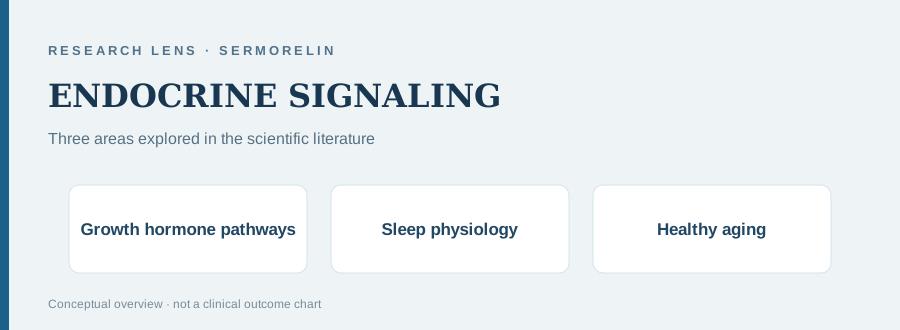
Aging is a biological process, not a single switch
The body does not cross an invisible line at 50 and suddenly become incapable of improvement. Aging involves gradual changes in multiple systems, including muscle, cardiovascular function, sleep, hormones, and the ways tissues respond to stress.
These changes are not uniform. Two men of the same age may have very different strength, mobility, body composition, and endurance. Training history, nutrition, health conditions, genetics, and daily activity all contribute.
This matters because the goal is not to find one molecule that explains every change. It is to understand the systems that influence the outcomes you care about.
For a man interested in looking and feeling exceptional at 60, endocrine biology is one part of that larger picture.
The hypothalamus and pituitary: a remarkable partnership
The hypothalamus helps coordinate internal signals associated with sleep, appetite, temperature, and hormonal regulation. It communicates with the pituitary gland, which releases hormones affecting many tissues throughout the body.
One of these is growth hormone. The hypothalamus produces growth hormone-releasing hormone (GHRH (Growth Hormone-Releasing Hormone)), which encourages the pituitary to release growth hormone. Another hypothalamic signal, somatostatin, suppresses its release.
This creates a dynamic system rather than a constant flow. Growth hormone is released in pulses, and its secretion varies with age, sleep, nutrition, and physiological circumstances.
A single laboratory measurement can therefore be difficult to interpret without the broader clinical context. What matters is how the system behaves, not simply one isolated number.
Where sermorelin enters the science
Sermorelin is a synthetic peptide corresponding to the active first 29 amino acids of human growth hormone-releasing hormone (GHRH (Growth Hormone-Releasing Hormone)). It interacts with receptors involved in stimulating growth hormone release from responsive pituitary tissue.
That mechanism distinguishes it from growth hormone itself. Sermorelin acts upstream, at the level of signaling, rather than directly supplying the downstream hormone.
Historically, sermorelin products marketed as Geref were used for certain pediatric growth hormone-related purposes and diagnostic assessment. Those products were discontinued, and the United States Food and Drug Administration (FDA) determined they had not been withdrawn for reasons of safety or effectiveness.
That historical regulatory decision is not an approval for generalized adult anti-aging use. It does, however, provide context for why sermorelin has a place in the scientific literature on pituitary physiology.
Growth hormone and its downstream signals
Growth hormone affects metabolism and interacts with the production of insulin-like growth factor 1 (IGF-1 (Insulin-Like Growth Factor 1)), a hormone involved in growth and tissue regulation.
The growth hormone and insulin-like growth factor 1 (IGF-1 (Insulin-Like Growth Factor 1)) pathways participate in normal physiology throughout life. Their activity changes with nutritional status, age, illness, and other signals.
Researchers have investigated these systems in relation to fat metabolism, lean tissue, connective tissue, and the body's responses to different conditions.
These are fascinating biological connections. They also illustrate why scientific claims require precision. A measured change in hormone concentration is not the same endpoint as greater strength, better recovery, or longer life.
Understanding that distinction allows you to appreciate a discovery for what it actually demonstrates.
Why body composition becomes a central question
For many men, the first visible sign that they want to make a change is their waistline. They may have trained consistently yet struggle to reveal the definition they have built underneath excess fat.
Body composition involves the relative amounts of fat mass, lean tissue, bone, and other components. It changes with activity, food intake, health, and age.
Growth hormone research has explored aspects of fat and protein metabolism. Some studies administering growth hormone to older adults have reported changes in body-composition measures, although a systematic review found that these changes did not consistently translate into better functional strength and were accompanied by adverse effects.
Those studies investigated growth hormone treatment, not proof that sermorelin produces equivalent outcomes. The distinction is important when interpreting discussions that group several endocrine interventions together.
The practical ambition remains straightforward: improve the ratio of strength and physical capability to unnecessary body fat, while preserving the health that allows you to remain active.
A deeper understanding of endocrine signaling can enrich the way you think about physical performance and the years ahead.
Sermorelin research: Aging is a biological process, not a single switch
Explore US Peptide Depot →Recovery is more than a hormone number
Imagine a 56-year-old who has just returned to serious lifting. He enjoys challenging himself, but he notices that a late night affects the next workout more than it once did.
It would be easy to search for one hormonal explanation. In reality, recovery reflects many systems working together: mechanical loading, nutrition, sleep, cardiovascular health, and the condition of muscles and connective tissues.
The most productive response is to build a repeatable training plan and observe how the body adapts. Does strength improve across months? Does energy remain stable? Are training sessions challenging without causing constant interruptions?
This broader perspective respects the complexity of the body while keeping attention on outcomes that matter in everyday life.
Sleep and the body's daily rhythm
Growth hormone secretion is associated with sleep, including prominent pulses during early-night slow-wave sleep in many adults.
That relationship has been studied for decades and remains one of the clearest examples of how endocrine regulation interacts with daily rhythms.
Sleep itself supports memory, attention, immune function, and recovery. For a man balancing work, fitness, and relationships, protecting sleep can make the entire week more manageable.
A consistent schedule, morning daylight, a comfortable sleeping environment, and thoughtful caffeine timing are practical parts of that effort. Persistent sleep problems deserve proper evaluation because their causes can vary.
You do not need an elaborate nighttime ritual to take sleep seriously. You need a routine you can repeat.

The reinvention mindset: moving from intensity to consistency
A man starting over after a long relationship may approach fitness with extraordinary motivation. He wants to see visible change and prove to himself that his future is still open.
That energy can be useful. But the transformation that lasts usually comes from converting enthusiasm into systems.
He trains even when the day is ordinary. He plans meals without making food the center of his identity. He learns to recover instead of punishing himself for needing rest.
As his physique changes, other parts of his life may begin to follow. He updates his wardrobe, reconnects with friends, or returns to interests he neglected for years.
The most valuable shift is psychological: he stops looking backward for proof of his worth and starts building a life that feels meaningful now.
Endocrine science fits naturally into this mindset because it encourages curiosity. The question becomes not “How can I reverse time?” but “How can I understand my body and make better decisions?”
What serious research is designed to answer
A useful study begins with a precise question. Researchers might measure pituitary responsiveness to a signal, changes in hormone concentrations, or specific functional outcomes.
These are different endpoints, and each tells us something different.
Sermorelin's capacity to stimulate growth hormone secretion is part of its established pharmacological history. Evidence for broader claims about improved athletic recovery or generalized longevity in healthy older men remains limited.
The scientific process involves connecting mechanistic findings with carefully measured outcomes, evaluating safety, and testing whether results can be reproduced.
This is not a less exciting version of science. It is what makes scientific knowledge valuable enough to guide real decisions.
Curiosity is a powerful part of reinvention when it is paired with the discipline to understand the evidence.
Go deeper: Recovery is more than a hormone number
Discover US Peptide Depot →Training for the man you want to be at 70
A good training plan should support your life rather than consume it. Resistance training helps maintain strength and function. Aerobic activity supports cardiovascular fitness. Mobility work and appropriate exercise selection can help you keep participating in the activities you enjoy.
A long-term approach may include tracking a few meaningful measures: strength on familiar exercises, waist circumference, walking endurance, and sleep quality.
The purpose is not to build a spreadsheet of every biological variable. It is to notice whether the life you are building is becoming more capable.
A man who can hike comfortably, lift consistently, and enjoy travel at 70 has achieved something worth respecting.
An understated vision of success
Picture yourself at 62. Your hair is silver, and you are comfortable with it. You have a lean physique, good posture, and a few reliable routines that make your days better.
You take a morning walk. You enjoy a well-prepared breakfast. You train because you like feeling strong. You have meaningful relationships and projects that keep you interested in the world.
Perhaps you have started dating again. Perhaps you have reached a stage where work no longer dictates every decision. Perhaps you are learning golf or finally taking the trips you once postponed.
You are not trying to impersonate a younger man. You are becoming an exceptional version of the man you are now.
That vision is built through years of ordinary decisions, supported by a willingness to keep learning.
Final perspective
Sermorelin is a synthetic growth hormone-releasing hormone (GHRH (Growth Hormone-Releasing Hormone)) analogue that has been studied for its effect on pituitary growth hormone secretion.
Its research history offers an introduction to endocrine signaling and the biological changes associated with aging. For men over 50, that science belongs within a broader commitment to training, sleep, nutrition, and physical capability.
Your next decade does not have to be defined by what you have lost. It can be defined by what you continue to build.
Stay curious. Stay capable. Keep becoming.
Keep exploring What Endocrine Research Can Teach Men After 50: An understated vision of success
Visit US Peptide Depot →Further reading on Reinvention Science
- Sermorelin After 50: Understanding Growth Hormone Signaling and the Biology of Recovery
- Sermorelin and Sleep After 50: Understanding the Nighttime Growth Hormone Rhythm
Scientific references
- Corpas E, Harman SM, Blackman MR. (1993). Human growth hormone and human aging. Endocrine Reviews.
- Liu H, et al. (2007). Systematic review: the safety and efficacy of growth hormone in the healthy elderly. Annals of Internal Medicine. This review examined administered growth hormone in older adults, not sermorelin.
- United States Food and Drug Administration: Geref withdrawal determination.
- Fragala MS, et al. (2019). Resistance Training for Older Adults: Position Statement. Journal of Strength and Conditioning Research.
Get the weekly digest
One email a week. Unsubscribe anytime.
More in Peptide Science
BPC-157 and Tendon Research After 50: Why Staying in the Game Matters
October 9, 2026 — A grounded look at BPC-157 research, tendon biology, progressive loading, and staying physically capable after 50.
Joint Recovery After 50: What BPC-157 Research Reveals About Tissue Repair
October 8, 2026 — A research-led look at BPC-157, joint health, injury biology, and how men over 50 can keep training with purpose.
The Comeback After 50: Training Injuries, Tendon Biology, and BPC-157 Research
October 7, 2026 — An evidence-led guide to tendon injuries, training consistency, and experimental BPC-157 research for men rebuilding strength after 50.
Discussion
Loading comments…