

Sermorelin After 50: Understanding Growth Hormone Signaling and the Biology of Recovery
A research-grounded look at sermorelin, growth hormone-releasing hormone, recovery biology, and physical longevity for men over 50.

At 30, you may have measured progress by how much harder you could train. At 50, you begin to appreciate something more sophisticated: how well your body responds to the work you ask it to do.
Maybe you're 54. You have built a career, kept commitments, and learned the value of discipline. You've also learned that time is not unlimited. The years move quickly, and the body you want at 65 is being shaped by the choices you make today.
You still lift. You still want a strong back, defined shoulders, and a lean waist. But recovery is no longer something you take for granted. Sleep matters. Training volume matters. You notice when a stressful week leaves you feeling less prepared for the next session.
That curiosity often leads men toward endocrine science: the study of how hormones carry messages through the body. One area of interest is sermorelin, a synthetic peptide related to growth hormone-releasing hormone (GHRH).
The story of sermorelin begins with a remarkable biological communication system linking the brain, the pituitary gland, and tissues throughout the body.
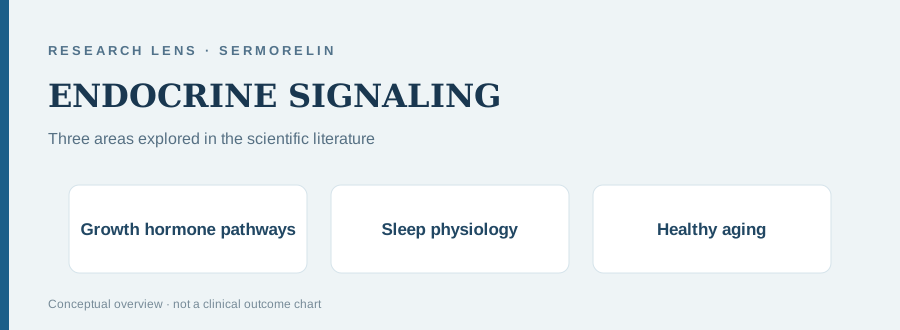
The body's hormonal communication network
Hormones are chemical messengers. They help coordinate processes that happen in different organs and tissues, often without conscious attention.
The hypothalamus, a region deep within the brain, participates in regulating temperature, appetite, sleep, and endocrine signaling. It communicates with the pituitary gland, which releases several hormones into circulation.
One of those hormones is growth hormone. Its secretion is controlled in part by growth hormone-releasing hormone (GHRH), which stimulates release, and somatostatin, which inhibits it.
This system is dynamic rather than constant. Growth hormone is secreted in pulses, and the size and timing of those pulses vary with sleep, age, nutrition, and other physiological conditions.
The rhythm is one reason a single hormone measurement cannot always tell the entire story. Endocrine function involves patterns, relationships, and responses—not merely one isolated number.
For a man who values understanding how his body works, the elegance of that system is worth appreciating.
What sermorelin is
Sermorelin is a synthetic version of the biologically active first 29 amino acids of human growth hormone-releasing hormone (GHRH). It interacts with receptors on pituitary cells involved in growth hormone release.
That is different from administering growth hormone directly. Sermorelin acts at an earlier point in the signaling pathway, provided the pituitary tissue can respond.
Historically, sermorelin was marketed in the United States under the Geref name for certain pediatric growth hormone-related uses and diagnostic purposes. Those products were later discontinued. The United States Food and Drug Administration (FDA) determined that their withdrawal was not for reasons of safety or effectiveness, a finding about the historical products rather than approval for new uses.
Researchers have used growth hormone-releasing hormone (GHRH) analogues to investigate pituitary responsiveness and aspects of endocrine physiology.
The key scientific finding is that sermorelin can stimulate growth hormone secretion under appropriate physiological conditions. Understanding what that response means for broader health outcomes requires attention to the specific population and outcome studied.
The growth hormone and insulin-like growth factor pathway
Growth hormone does not operate alone. One of its downstream effects involves insulin-like growth factor 1 (IGF-1), which is produced in the liver and other tissues.
Growth hormone and insulin-like growth factor 1 (IGF-1) participate in growth, metabolism, and tissue regulation. Their relationship is influenced by age, nutritional status, illness, and other endocrine signals.
In childhood and adolescence, these pathways are especially important for normal development. In adults, they remain involved in metabolism and tissue physiology.
This is why the system attracts interest from scientists studying aging. Hormonal signals continue to change throughout life, and researchers want to understand how those changes relate to body composition and function.
But a hormonal change is not automatically the same as an improvement in strength, athletic recovery, or longevity. Those are distinct outcomes that require their own measurements.
The most useful perspective is to understand the pathway before drawing conclusions about what manipulating it might accomplish.
Why growth hormone secretion changes with age
Growth hormone secretion generally declines from early adulthood into later life. Scientists have sometimes described this age-associated change using the term somatopause.
That change happens alongside many other developments. Activity levels may shift. Sleep patterns can become less consistent. Body composition can change. Recovery may feel different after demanding exercise.
These processes interact, but they should not be reduced to a single hormone.
A 55-year-old who sleeps poorly, trains inconsistently, and eats too little protein may feel different from a similarly aged man with stable routines, even if their chronological ages are identical.
This is an important distinction for anyone interested in longevity. Age influences physiology, but daily behaviors and medical history also shape how we function.
The practical advantage of understanding endocrine science is not the belief that one molecule explains everything. It is the ability to ask more precise questions about the systems involved.
What researchers have learned from growth hormone studies
Research on growth hormone and growth hormone-releasing hormone (GHRH) pathways has explored body composition, metabolic regulation, and aspects of aging physiology.
Some studies involving growth hormone administration in older adults reported changes in lean mass and fat mass. However, a systematic review of growth hormone use in healthy older people did not find consistent corresponding improvements in functional strength and identified adverse effects.
Those findings concern growth hormone treatment itself, not direct evidence that sermorelin produces the same outcomes.
This distinction illustrates an important principle in research: compounds that influence the same broad pathway are not necessarily interchangeable.
Sermorelin-specific studies have established its ability to stimulate pituitary growth hormone secretion. Evidence supporting claims about improved athletic recovery or general anti-aging outcomes in healthy older adults is much more limited.
Understanding the difference between a demonstrated hormonal response and a proven real-world benefit makes the science more useful.
The body's endocrine systems are an extraordinary subject for anyone serious about understanding performance and aging.
Sermorelin research: The body's hormonal communication network
Explore US Peptide Depot →Why recovery becomes a priority for the experienced lifter
Imagine two men, both 56. Both enjoy lifting weights. Both want to remain strong into their seventies.
One trains with the same routine he used twenty years ago, regardless of how he sleeps or feels. The other pays attention to the quality of his repetitions, his weekly workload, and his recovery.
Over time, those choices can influence consistency.
For the second man, recovery is not a sign of weakness. It is part of a disciplined training strategy. He understands that productive stress must be paired with adaptation.
The endocrine system is one part of that adaptation. But mechanical loading, nutrition, cardiovascular fitness, sleep, and injury history also matter.
The objective is not to chase the sensation of a hard workout. It is to create a body that continues responding to training over years.
That kind of patience often comes more naturally with age. Experience teaches you that sustainable progress is usually more valuable than a brief peak.
Sleep and hormonal rhythms
Growth hormone secretion is closely associated with sleep, particularly the early-night periods of slow-wave sleep.
This relationship makes sleep an interesting part of endocrine physiology. It also provides a practical reminder that recovery does not begin when you enter the gym. It begins with the structure of your daily life.
A consistent sleep schedule, a comfortable sleeping environment, and attention to sleep disorders can all support general health and functioning.
Sleep affects cognition, mood, energy, and the ability to train effectively. These benefits extend far beyond one hormone pathway.
For the man who has spent years sacrificing sleep for professional responsibilities, protecting his nights may be one of the most meaningful changes he makes.
He may discover that progress requires not more hours of effort, but better use of the hours he already has.

The identity shift that happens after 50
There is a moment when a man realizes that the next chapter of his life deserves deliberate attention.
Perhaps a long relationship has ended. Perhaps a career has reached a stable point. Perhaps he simply looks at an old photograph and realizes that ten years passed more quickly than he expected.
He decides to take his physical health seriously again.
At first, the goals are visible: a smaller waist, stronger shoulders, a better-fitting shirt.
Then the process becomes more interesting. He starts learning about nutrition, sleep, training adaptation, and the biological systems involved in recovery.
The curiosity itself becomes part of reinvention.
He is no longer merely trying to correct a problem. He is developing a deeper understanding of how to remain capable.
That shift can bring a quiet form of confidence. Not the confidence of having every answer, but the confidence of being willing to learn and act thoughtfully.
The next chapter of physical performance begins with the decision to keep learning.
Go deeper: Why recovery becomes a priority for the experienced lifter
Discover US Peptide Depot →Building a long-term performance dashboard
A sophisticated approach to health uses more than one measure of success.
Strength is one useful marker. Tracking performance on repeatable exercises can reveal trends in physical capacity.
Waist circumference and body composition can provide information beyond total body weight. Cardiovascular fitness, mobility, sleep quality, and daily energy also matter.
Clinical measurements can add context when selected for a meaningful reason and interpreted appropriately.
The goal is not to collect every possible number. It is to choose a few indicators that reflect the life you want to lead.
If your goal is to hike comfortably at 65, walking endurance matters. If you want to remain a capable lifter, strength and joint function matter. If you want to enjoy travel and social life, sleep and energy matter.
The best dashboard is personal, practical, and stable enough to show change over time.
The science of growth hormone is not the whole story of longevity
Longevity is sometimes marketed as though it could be reduced to a single molecule or hormone.
Human aging is far more complex. It involves genetics, cardiovascular health, metabolic regulation, immune function, tissue maintenance, and the accumulated effects of daily behaviors.
Growth hormone signaling is one part of that network.
Understanding it can deepen appreciation for endocrine biology, but it does not replace the evidence supporting exercise, nutrition, preventive care, and meaningful social connection.
That broader perspective fits the aspirations of men who want to remain engaged with life rather than merely pursue a particular laboratory number.
The real goal is to stay capable enough to do the things that make life rewarding.
Picture the man you want to become at 65
Imagine a morning fifteen years from now.
You wake up in a home filled with light. You make coffee, stretch, and take a walk before the day begins.
Your hair is silver. Your posture is strong. You still lift weights because you enjoy the process.
You have meaningful relationships, a few close friends, and projects that keep your curiosity alive.
Perhaps you are learning golf. Perhaps you travel more often. Perhaps you have finally made room for a creative pursuit that spent years waiting in the background.
You are not trying to recreate your twenties.
You are building a version of your sixties that reflects everything you have learned.
The work begins with choices made now: training consistently, recovering intelligently, eating well, and continuing to learn.
Final perspective
Sermorelin is a synthetic growth hormone-releasing hormone (GHRH) analogue studied for its ability to stimulate pituitary growth hormone release.
Its research history offers a useful window into endocrine signaling, growth hormone physiology, and the biological changes that accompany aging.
For men over 50, the larger opportunity is to understand how the body's systems work together—and to build habits that support strength, recovery, and long-term physical capability.
Your next decade does not have to be a retreat from the man you once were.
It can be a deliberate progression toward the man you are still becoming.
Keep exploring Understanding Growth Hormone Signaling and the Biology of Recovery: Picture the man you want to become at 65
Visit US Peptide Depot →Further reading on Reinvention Science
- Sermorelin and Sleep After 50: Understanding the Nighttime Growth Hormone Rhythm
- Sermorelin and Body Composition After 50: Understanding the Hormonal Signals Behind Change
Scientific references
- Corpas E, Harman SM, Blackman MR. (1993). Human growth hormone and human aging. Endocrine Reviews.
- Liu H, et al. (2007). Systematic review: the safety and efficacy of growth hormone in the healthy elderly. Annals of Internal Medicine. This review examined administered growth hormone in older adults, not sermorelin.
- United States Food and Drug Administration (FDA): Geref withdrawal determination.
- Fragala MS, et al. (2019). Resistance Training for Older Adults: Position Statement. Journal of Strength and Conditioning Research.
Get the weekly digest
One email a week. Unsubscribe anytime.
More in Peptide Science
BPC-157 and Tendon Research After 50: Why Staying in the Game Matters
October 9, 2026 — A grounded look at BPC-157 research, tendon biology, progressive loading, and staying physically capable after 50.
Joint Recovery After 50: What BPC-157 Research Reveals About Tissue Repair
October 8, 2026 — A research-led look at BPC-157, joint health, injury biology, and how men over 50 can keep training with purpose.
The Comeback After 50: Training Injuries, Tendon Biology, and BPC-157 Research
October 7, 2026 — An evidence-led guide to tendon injuries, training consistency, and experimental BPC-157 research for men rebuilding strength after 50.
Discussion
Loading comments…