

BPC-157 and the Future of Recovery Research: What Men Over 50 Should Understand
Explore BPC-157 (Body Protection Compound 157), tissue repair biology, recovery research, and the science of staying active after 50.

There is a certain satisfaction in being 55 and discovering that you still have the ambition to improve. You might not recover exactly as you did at 25, but you have something your younger self lacked: the experience to train with purpose.
For some men, the decision to return to fitness follows a long relationship ending. For others, it comes after years spent building a business or raising a family. You may have reached a point where you can afford the time to take care of yourself—and you intend to use it.
The first few weeks can feel remarkable. You sleep better, regain a familiar rhythm, and remember how much you enjoy the challenge of lifting. Then a shoulder starts complaining after pressing. An old knee problem reappears after a hike. Or your elbow becomes irritated by pull-ups.
That is when recovery stops being an afterthought.
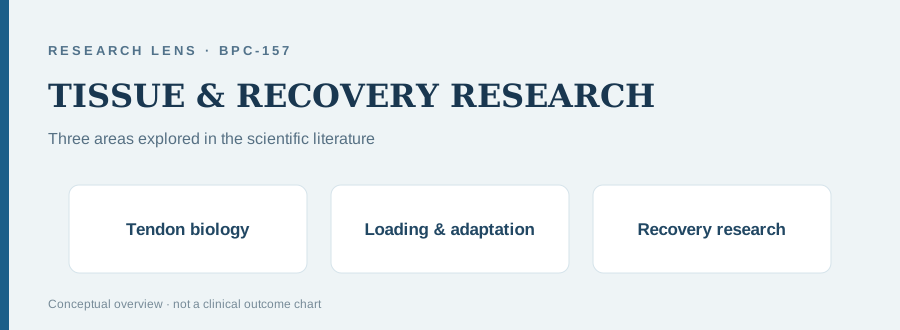
A growing body of research examines how tissues respond to injury, mechanical loading, inflammation, and repair signals. Within that landscape, BPC-157 (Body Protection Compound 157) has become a widely discussed experimental peptide. Its story offers a window into the biology of recovery—and into the importance of understanding what different kinds of research can actually tell us.
The real goal is to remain capable
For a man in midlife, physical fitness is rarely just about lifting a heavier barbell. It is about having options.
You want to feel comfortable in a fitted shirt. You want to travel without worrying about your knees. You want to be able to take a spontaneous hike, play racquetball, or spend a day on a golf course.
Those experiences depend on the condition of more than your muscles. Tendons connect muscle to bone. Ligaments help stabilize joints. Cartilage provides specialized surfaces for movement. Each tissue has different properties and a different response to stress.
When these systems are working well together, you barely notice them. When one becomes irritated, the limitation can dominate your training.
Recovery research is therefore relevant to a much bigger question: how can we preserve the physical freedom that makes the next decades enjoyable?
Why BPC-157 (Body Protection Compound 157) interests researchers
BPC-157 (Body Protection Compound 157) is a synthetic chain of fifteen amino acids. Scientists have investigated its effects in experimental models of tissue injury, including musculoskeletal and gastrointestinal systems.
The compound is not the same as an established prescription therapy. Its relevance in the research literature comes primarily from preclinical studies exploring biological signaling and tissue responses.
In these studies, investigators have examined processes involving fibroblasts, collagen organization, vascular pathways, and inflammatory mediators. Each of these has a role in the complex sequence of events that follows an injury.
A 2025 systematic review in HSS Journal identified 36 studies relevant to orthopedic sports medicine: 35 preclinical studies and one small retrospective clinical study. The imbalance is an important description of the research field. Most of the detailed mechanistic observations were made in experimental settings rather than large, controlled human trials.
That makes the literature useful for understanding scientific hypotheses, while leaving many clinical questions open.
Recovery is a sequence, not a switch
Imagine that a tendon has been exposed to more force than it can tolerate. The body's response is not simply to turn pain off and resume normal function.
Cells communicate. Local inflammatory processes change. Structural proteins are produced and reorganized. Mechanical forces influence how the recovering tissue adapts.
One important participant is the fibroblast, a cell involved in producing components of connective tissue. Another is collagen, whose organization contributes to the strength and mechanical behavior of tendons and ligaments.
Blood vessels also matter. Tissues need oxygen and nutrients, and the vascular environment can influence repair.
Scientists studying experimental peptides ask whether a particular molecule changes any of these steps. The question is precise: what happens to a specific signaling pathway or measurable tissue property under a defined set of conditions?
This is more informative than the broad phrase “speeds recovery,” which can mean different things depending on whether the outcome is pain, tissue structure, strength, or time until normal activity.
What the laboratory findings explore
Preclinical BPC-157 (Body Protection Compound 157) research has examined several recurring themes.
Cell migration and tissue organization. Some experiments have investigated how cells involved in repair respond to injury and how the extracellular matrix is reorganized.
Vascular signaling. Researchers have studied pathways associated with blood-vessel behavior and the local environment of injured tissue.
Inflammatory signaling. Studies have measured selected biological responses after experimental injury, looking at whether signaling patterns differ between study groups.
Mechanical properties. Animal experiments sometimes evaluate structural measures such as how much force a healing tissue tolerates before failure.
These are meaningful scientific questions because tissue repair involves both biology and mechanics. A tendon that appears improved under a microscope must still perform when loaded. A joint that feels comfortable must still be able to support movement.
The strongest future research will connect these different outcomes rather than relying on one laboratory measurement.
Why this conversation resonates with experienced lifters
Picture a 57-year-old man who has trained for years. He is strong, but he has learned to be selective. He no longer feels compelled to chase personal records every week.
His goals have changed. He wants to maintain a lean waist, preserve his shoulders and back, and continue lifting into his seventies.
He also wants to enjoy life outside the gym. Maybe he is newly single and looking forward to meeting people again. Maybe he is traveling more often. Maybe he has finally reached a stage where work no longer consumes every waking hour.
A recurring joint problem can feel like an interruption to all of that momentum.
Learning about tissue biology can make the experience less mysterious. Instead of seeing discomfort as a verdict on aging, he can begin asking better questions about workload, recovery, exercise selection, and the condition of the tissues involved.
Scientific curiosity does not replace practical habits. It can make those habits more intelligent.
Understanding recovery science is one way to keep the conversation about strength and longevity moving forward.
BPC-157 research: The real goal is to remain capable
Explore US Peptide Depot →The difference between a biological signal and a real-world outcome
One of the most valuable habits in reading research is to identify the outcome being measured.
A study may report a change in a signaling protein. Another may describe tissue appearance under a microscope. A third may measure the force required to damage a healing tendon.
These findings answer different questions.
For a man returning to the gym, the outcomes that matter most are often practical: can he train comfortably, regain function, and return to activities he enjoys?
That is why well-designed human research remains central to understanding experimental compounds. In the case of BPC-157 (Body Protection Compound 157), clinical evidence for musculoskeletal recovery remains limited, and its effectiveness for these uses has not been established.
The United States Food and Drug Administration (FDA) has also identified safety concerns relevant to compounded BPC-157 (Body Protection Compound 157), including potential immunogenicity and peptide-related impurities.
These are aspects of the scientific record, distinct from the mechanistic findings that first drew research interest.
Training habits that support long-term resilience
A man who wants to remain athletic for decades benefits from a recovery strategy he can actually follow.
Use progressive loading. Increase demands in a way your muscles and connective tissues can adapt to. Sudden jumps in intensity or volume can be difficult to tolerate.
Keep a training record. A log can reveal when a new exercise, extra session, or abrupt change in workload coincides with discomfort.
Choose movements you can repeat. The best exercise is not always the most impressive-looking one. It is often the movement that allows consistent, meaningful progress without unnecessary irritation.
Protect sleep. Recovery takes place within a broader physiological system influenced by rest, stress, and overall health.
Eat to support the work. Adequate energy and protein help support normal tissue maintenance and training adaptation.
Respect persistent symptoms. Pain that does not improve, or that interferes with normal activity, deserves an informed assessment rather than endless attempts to train around it.
These habits are not dramatic. Their value lies in how reliably they support the next session, the next month, and the next year.

Recovery and identity after a major life change
A breakup or divorce can change how a man experiences his days. Routines disappear. Familiar plans no longer apply. Time that was once shared becomes his to manage.
Training can provide structure during that transition. There is something grounding about showing up, doing the work, and seeing measurable progress.
But the deeper transformation is not about proving something to a former partner.
It is about becoming the kind of man who keeps promises to himself.
You may start by wanting a smaller waist or broader shoulders. Over time, the goal becomes larger: better sleep, a calmer mind, a body you trust, and a future that feels open.
Recovery is part of that process because consistency requires the ability to keep participating. A training program that repeatedly breaks down is not a better program simply because it looks demanding on paper.
The most impressive transformation is one that can continue.
A strong next chapter is built through curiosity, discipline, and the willingness to keep improving.
Go deeper: The difference between a biological signal and a real-world outcome
Discover US Peptide Depot →The science of patience
Connective tissue adaptation often moves on a different timetable from motivation. You can feel eager to increase your training load before a tendon has fully adapted.
This is one reason experienced athletes learn to value patience. They understand that small, repeatable improvements can accumulate into substantial progress.
A 52-year-old who adds a little strength every month, keeps his joints functioning, and remains consistent may be in a better position at 60 than someone who repeatedly alternates between extreme effort and forced time off.
The same principle applies to other parts of reinvention.
A better diet is built meal by meal. Financial freedom is built through decisions that compound. A satisfying social life is built by showing up and developing relationships over time.
Physical resilience follows a similar logic.
The goal is not to force the future to arrive immediately. It is to build a system that makes the future worth reaching.
What future recovery research may clarify
The most useful next steps for the scientific field involve connecting laboratory observations with carefully measured human outcomes.
Researchers need to understand which experimental findings reproduce reliably, whether they translate between species, and how formulation and exposure influence results.
For tissue repair, outcomes might include functional recovery, pain, return to activity, and long-term durability. Safety matters alongside any potential benefit.
These questions reflect the normal process of moving from an interesting biological hypothesis toward a clinical understanding.
For readers of Reinvention Science, that process is worth following because it reveals how discoveries are tested, challenged, and refined.
Curiosity becomes more valuable when paired with an appreciation for how knowledge is built.
The man you want to be at 65
Imagine waking up at 65 and looking forward to the day.
You have a walk planned, a workout you enjoy, and perhaps a trip on the calendar. Your body has changed with age, but it still supports the activities that matter to you.
You have gray hair and experience. You are comfortable with both.
You have built meaningful friendships, learned new skills, and made room for relationships that add to an already satisfying life.
You are not measuring success by whether you can recreate your twenties. You are measuring it by whether you remain engaged, capable, and curious.
That is the larger reason recovery science matters.
It contributes to our understanding of how bodies respond to stress and how function can be preserved over time.
The goal is not to escape aging. It is to participate fully in the years ahead.
Final perspective
BPC-157 (Body Protection Compound 157) is an experimental peptide that has attracted scientific interest through research on tissue-repair pathways, cellular signaling, and musculoskeletal injury models.
For men over 50, the wider story is about the value of recovery, the complexity of connective tissue, and the importance of building a body that can keep up with their ambitions.
The best next chapter is not necessarily the one with the heaviest lift or the fastest transformation.
It is the one in which you remain strong enough to keep doing what you love.
The future belongs to the man who continues building it.
Keep exploring What Men Over 50 Should Understand: The man you want to be at 65
Visit US Peptide Depot →Further reading on Reinvention Science
- BPC-157 and Tendon Research After 50: Why Staying in the Game Matters
- Joint Recovery After 50: What BPC-157 Research Reveals About Tissue Repair
Scientific references
- Vasireddi N, et al. (2025). Emerging Use of BPC-157 in Orthopaedic Sports Medicine: A Systematic Review. HSS Journal.
- Regeneration or Risk? A Narrative Review of BPC-157 for Musculoskeletal Healing (2025).
- Fragala MS, et al. (2019). Resistance Training for Older Adults: Position Statement. Journal of Strength and Conditioning Research.
- United States Food and Drug Administration (FDA): Certain Bulk Drug Substances That May Present Significant Safety Risks.
Get the weekly digest
One email a week. Unsubscribe anytime.
More in Peptide Science
BPC-157 and Tendon Research After 50: Why Staying in the Game Matters
October 9, 2026 — A grounded look at BPC-157 research, tendon biology, progressive loading, and staying physically capable after 50.
Joint Recovery After 50: What BPC-157 Research Reveals About Tissue Repair
October 8, 2026 — A research-led look at BPC-157, joint health, injury biology, and how men over 50 can keep training with purpose.
The Comeback After 50: Training Injuries, Tendon Biology, and BPC-157 Research
October 7, 2026 — An evidence-led guide to tendon injuries, training consistency, and experimental BPC-157 research for men rebuilding strength after 50.
Discussion
Loading comments…