

GHK-Cu (Glycyl-L-Histidyl-L-Lysine Copper Complex) After 50: Collagen Science and the Art of Aging Well
Explore copper peptide research, collagen biology, skin structure, and a confident approach to visible aging after 50.
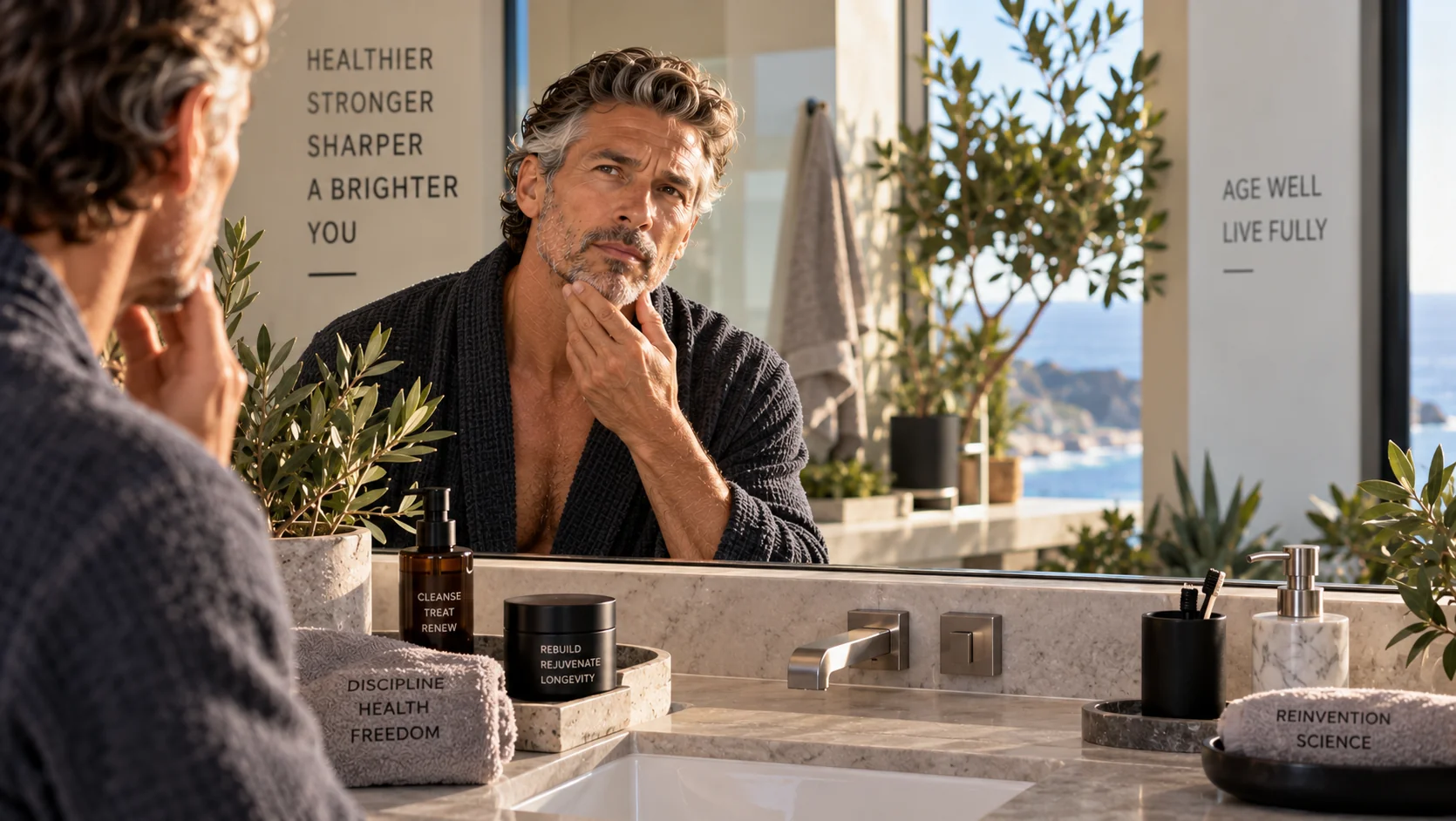
There is a difference between looking your age and looking as though you have stopped taking care of yourself. One is a natural consequence of living. The other is something you can decide to address.
At 52, you might be in better physical condition than you were at 42. You've rediscovered lifting, refined your diet, and started protecting time for sleep and walking. You feel sharper and more intentional. Yet when you catch your reflection in an unfamiliar mirror, you notice that your face tells a different story from your renewed energy.
Perhaps the skin around your eyes looks less firm. Maybe your cheeks have changed, or years of sun exposure have become more visible. You are not interested in pretending to be 30. You want the face in the mirror to belong to a man who looks healthy, engaged, and well cared for.
This is why the science of skin structure matters. It is also why researchers have examined GHK-Cu (Glycyl-L-Histidyl-L-Lysine Copper Complex), a naturally occurring copper-binding peptide complex associated with several biological pathways involved in tissue maintenance.
The most interesting story is not about erasing time. It is about understanding what happens to skin as we age—and why collagen remains central to that story.
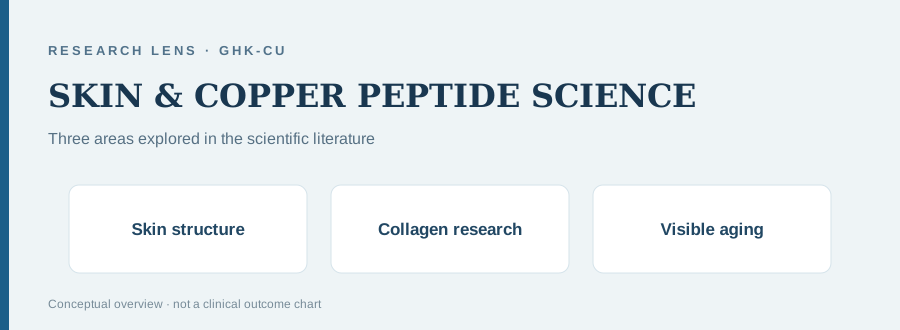
What makes skin look healthy?
Healthy-looking skin is the visible result of many interconnected systems. The outer epidermis forms a barrier against the environment. Below it, the dermis contains structural proteins, blood vessels, cells, and a network of supporting material known as the extracellular matrix.
Collagen provides much of the skin's tensile strength. Elastin contributes to elasticity. Water content, pigmentation, surface texture, and the distribution of facial fat all influence appearance.
This is why two men of the same age can look very different. Genetics matter, but so do years of sun exposure, smoking history, nutrition, sleep, and ordinary variation in skin biology.
Visible aging is not one event. It is the cumulative effect of many changes, unfolding at different rates.
For a man who wants to look exceptional in his fifties and sixties, understanding these systems is more useful than chasing a single cosmetic promise.
Introducing the copper-binding peptide
GHK-Cu (Glycyl-L-Histidyl-L-Lysine Copper Complex) consists of the tripeptide glycyl-L-histidyl-L-lysine bound to a copper ion. The peptide portion occurs naturally in the body and has been investigated in human plasma and tissue biology.
Copper is an essential trace element. It participates in enzymes involved in connective-tissue formation and other physiological functions. The ability of a peptide to bind copper creates interesting questions about how that complex behaves in biological systems.
Researchers have examined the copper complex in connection with fibroblast activity, extracellular-matrix remodeling, and cellular responses associated with tissue maintenance.
These investigations help explain why the compound has attracted interest in dermatology and cosmetic science.
A scientific mechanism is a way to understand how a biological process might work. In skin research, scientists connect that mechanism with observations about texture, structure, and appearance.
Collagen is architecture, not decoration
Think of collagen as part of the framework that gives skin its physical character.
Collagen fibers help the dermis resist stretching and maintain structural integrity. Their quantity, arrangement, and interactions with other matrix components affect firmness and texture.
With age, changes occur in collagen synthesis, breakdown, and organization. Ultraviolet radiation adds another layer of stress, contributing to photoaging through processes that affect collagen and other skin structures.
This helps explain why the face, neck, and hands often show visible aging earlier than areas that have received less sunlight.
Collagen research therefore reaches beyond beauty trends. It is part of understanding connective tissue, wound healing, and the body's ongoing efforts to maintain structural integrity.
For someone who has invested years in building a strong physique, the analogy is familiar. Muscle shape reflects the structure underneath. Skin appearance also depends on an underlying framework.
Why fibroblasts matter
Fibroblasts are cells involved in producing and maintaining components of the extracellular matrix. They participate in collagen production and respond to biochemical and mechanical signals from their environment.
Experimental work involving GHK-Cu (Glycyl-L-Histidyl-L-Lysine Copper Complex) has explored effects on fibroblast-related pathways and tissue remodeling.
A 2018 review by Pickart and Margolina discussed gene-expression and preclinical findings associated with the peptide. An earlier review examined multiple cellular pathways related to skin regeneration.
These papers help map the scientific questions researchers are asking: how do signals influence matrix organization, cellular activity, and repair processes?
The research includes laboratory and preclinical work alongside smaller cosmetic investigations. Keeping those study types distinct makes the scientific picture clearer.
The larger lesson is that visible skin health begins with processes taking place well below the surface.
The biology of skin renewal is a fascinating part of the wider science of human performance and aging.
GHK-Cu research: What makes skin look healthy?
Explore US Peptide Depot →The difference between a polished appearance and chasing youth
Imagine a 55-year-old man preparing for dinner with someone he has recently met.
He chooses a well-fitting shirt, trims his hair, and takes a moment to look in the mirror. His hair is silver. There are lines around his eyes. Neither bothers him particularly.
What matters is that he looks like himself at his best.
He has been working out regularly. His posture is better. His waistline is leaner. His energy is no longer buried beneath years of inconsistent routines.
The attention he gives his skin fits naturally into that broader transformation.
It is not about winning approval from a former partner or competing with younger men. It is about becoming comfortable in his own appearance again.
For some men, this shift begins after a divorce. For others, it follows a milestone birthday or a realization that work has occupied too much of their lives.
The circumstances differ, but the underlying ambition is similar: take care of the person who will accompany you through every remaining decade.
What cosmetic research investigates
Copper-peptide-containing cosmetic formulations have been studied in relation to selected measures of skin appearance, including fine lines, texture, and firmness.
These are not all the same endpoint. A change in surface hydration is different from a change in dermal collagen. A laboratory measure of gene expression is different from a visible result measured in a controlled human study.
Researchers also need to consider the formulation itself. A finished skincare product may contain other active ingredients, and delivery through the skin depends on the formulation and skin barrier.
For that reason, the evidence for a topical cosmetic preparation cannot automatically be transferred to a different route of administration.
This distinction is particularly relevant because online discussions sometimes combine topical research with claims about experimental injections. The published evidence for one formulation does not establish the effects or safety of another.
The most productive way to read the science is to ask what was tested, how it was delivered, and which outcome was measured.

Skin health is a daily practice
A sophisticated approach to skin appearance does not have to be complicated.
Sun protection is one of the most evidence-supported habits for reducing ultraviolet-related skin damage. It is especially relevant for men who enjoy golf, hiking, driving with the windows down, or spending time at the coast.
Adequate nutrition supports normal tissue maintenance. Protein provides amino acids used throughout the body, while a varied diet supplies vitamins and minerals involved in many cellular processes.
Sleep and general health also shape how you feel and function. A consistent routine is more valuable than an elaborate routine that you abandon after a week.
For some men, a simple skincare approach may include a gentle cleanser, moisturizer, and appropriate sunscreen. Evidence-based topical treatments can be considered according to individual skin concerns.
The appeal of this approach is its understatement. You do not need a shelf full of products to demonstrate that you take yourself seriously.
You need habits that fit the life you want to lead.
Skin biology and the larger reinvention mindset
There is a reason appearance becomes more interesting when other parts of life are improving.
When you start lifting consistently, you notice how you stand. When you improve your diet, you pay attention to how your clothes fit. When you sleep better, you may become more aware of the way your face looks in the morning.
Progress in one area encourages curiosity in another.
That curiosity is valuable. It turns vague dissatisfaction into specific questions you can investigate.
What influences collagen? What causes photoaging? How does the skin barrier function? Which ingredients have been studied, and what outcomes were measured?
The questions become more useful as they become more precise.
This is the spirit of Reinvention Science: not a frantic attempt to deny age, but a deliberate effort to understand the body and make thoughtful decisions about the years ahead.
A well-maintained appearance is one expression of a larger commitment to staying engaged with life.
Go deeper: What cosmetic research investigates
Discover US Peptide Depot →What aging well looks like at 60
Picture yourself at 60, standing on a terrace overlooking the coast.
Your hair is more silver than it was a decade earlier. You have a few additional lines around your eyes. But you are lean, energetic, and comfortable in your appearance.
You are dressed simply. Nothing about your style needs to announce itself.
You have projects that interest you, friends you enjoy, and perhaps a relationship that adds warmth to an already satisfying life.
You still train because you like being strong. You walk because it clears your mind. You take care of your appearance because it reflects the standards you have chosen for yourself.
That is a different ambition from trying to look 30.
It is the ambition to become an exceptional 60-year-old.
The difference matters because it allows you to appreciate experience rather than apologize for it.
Where research fits into the next decade
Research into GHK-Cu (Glycyl-L-Histidyl-L-Lysine Copper Complex) belongs within a broader scientific effort to understand tissue signaling, collagen remodeling, and skin physiology.
Scientists investigate mechanisms in laboratory models, evaluate formulations, and design studies that connect biological observations with meaningful outcomes.
This work sits alongside decades of research into sun exposure, connective-tissue biology, skin-barrier function, and dermatological care.
For the reader, the opportunity is to become more informed—not merely about one peptide, but about the processes that shape visible aging.
That knowledge can make the entire subject feel less mysterious.
It replaces vague promises with specific biological questions, and it connects appearance with the deeper systems that maintain the body over time.
Final perspective
GHK-Cu (Glycyl-L-Histidyl-L-Lysine Copper Complex) is a copper-binding peptide complex investigated for its interactions with collagen-related pathways, fibroblast activity, and tissue remodeling.
The research offers an intriguing perspective on the biological processes involved in skin maintenance.
For men over 50, the larger story is about pride, self-respect, and the freedom to keep improving.
You do not have to erase the evidence of a life well lived. You can aim to look healthy, capable, and exceptionally well cared for at the age you are.
Your next chapter is still being written. Make it one you are proud to see in the mirror.
Keep exploring Collagen Science and the Art of Aging Well: Where research fits into the next decade
Visit US Peptide Depot →Further reading on Reinvention Science
- GHK-Cu (Glycyl-L-Histidyl-L-Lysine Copper Complex) and Hair Biology After 50: The Science Behind a Well-Kept Appearance
- GHK-Cu (Glycyl-L-Histidyl-L-Lysine Copper Complex) and Visible Skin Aging: The Science of Texture, Firmness, and Self-Respect
Scientific references
- Pickart L, Margolina A. (2018). Regenerative and Protective Actions of the GHK-Cu Peptide in the Light of the New Gene Data. International Journal of Molecular Sciences.
- Pickart L, Margolina A. (2015). GHK Peptide as a Natural Modulator of Multiple Cellular Pathways in Skin Regeneration. BioMed Research International.
- Mokhtar J, et al. (2026). The Regenerative Potential of GHK-Cu in Aesthetic Medicine. Aesthetic Surgery Journal. Systematic review of 20 studies, including 18 preclinical studies and two randomized clinical trials.
- Mateescu D-M, et al. (2026). GHK-Cu as a Bioactive Metallopeptide and Drug-Delivery Cargo: Coordination Chemistry, Formulation Science, Therapeutic Evidence, and a Translational Roadmap. Pharmaceutics. Structured evidence-mapping review of formulation and translational research.
Get the weekly digest
One email a week. Unsubscribe anytime.
More in Peptide Science
BPC-157 and Tendon Research After 50: Why Staying in the Game Matters
October 9, 2026 — A grounded look at BPC-157 research, tendon biology, progressive loading, and staying physically capable after 50.
Joint Recovery After 50: What BPC-157 Research Reveals About Tissue Repair
October 8, 2026 — A research-led look at BPC-157, joint health, injury biology, and how men over 50 can keep training with purpose.
The Comeback After 50: Training Injuries, Tendon Biology, and BPC-157 Research
October 7, 2026 — An evidence-led guide to tendon injuries, training consistency, and experimental BPC-157 research for men rebuilding strength after 50.
Discussion
Loading comments…